“Only Russians can do this…”, “What is there to fear if you are Russian?”, “If sincerity exists, it exists only in Russia,” “Russia is a country where no one is left alone in their trouble” — under such emotional slogans, a wave of propaganda videos is spreading across YouTube, Instagram, and TikTok. These videos, garnering millions of views by idealizing Russian culture and mentality, are in fact part of a coordinated campaign to promote the concept of the “Russian World” (Russkiy Mir) through manipulative technologies.
Digital Infrastructure and Manipulation Techniques
The infrastructure of this network includes at least 13 channels on the YouTube platform alone. Through reverse image searches of video screenshots, we identified similar accounts on Instagram, Facebook, and TikTok.
The discovered YouTube channels within this network were mostly created between 2025 and 2026. One channel, dating back to 2007, draws particular attention. Threat actors often purchase abandoned or stolen legacy accounts with a long history and high trust ratings from YouTube’s algorithms. This allows them to push new videos into “Top” recommendations more quickly and bypass platform restrictions.
Data regarding the channels’ country of origin reveal an attempt to conceal the “original footprint.” Among the identified locations are Russia, Poland, and Kazakhstan, though a significant portion of the channels have hidden their location data.
Individual videos garner between 1 and 3.3 million views on YouTube. Despite the pages having different names and the content only partially overlapping across channels on a single platform, they are united by a common principle of visual and narrative editing.
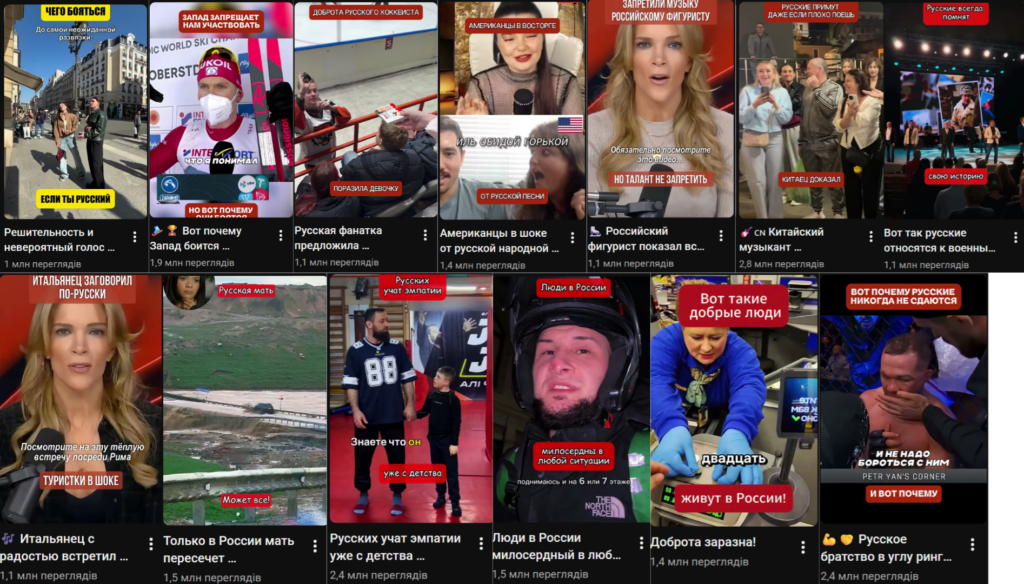
Examples of videos from the network promoting the “Russian World” ideology
The content creation technology is based on merging two video streams. Propagandists use clips from broadcasts of well-known American media personalities, such as Tucker Carlson (an American conservative TV host, also known for his controversial interview with the Russian president), Megyn Kelly (an American conservative journalist, TV host, and political commentator), or Candace Owens (an American conservative blogger and political activist). New voiceovers or subtitles are overlaid onto the original footage of the hosts, creating the illusion that Western influencers are admiring clips of Russian life. The secondary footage, presented as the subject of the broadcast, consists of actual videos of Russian life, snippets from bloggers, or footage from political events.
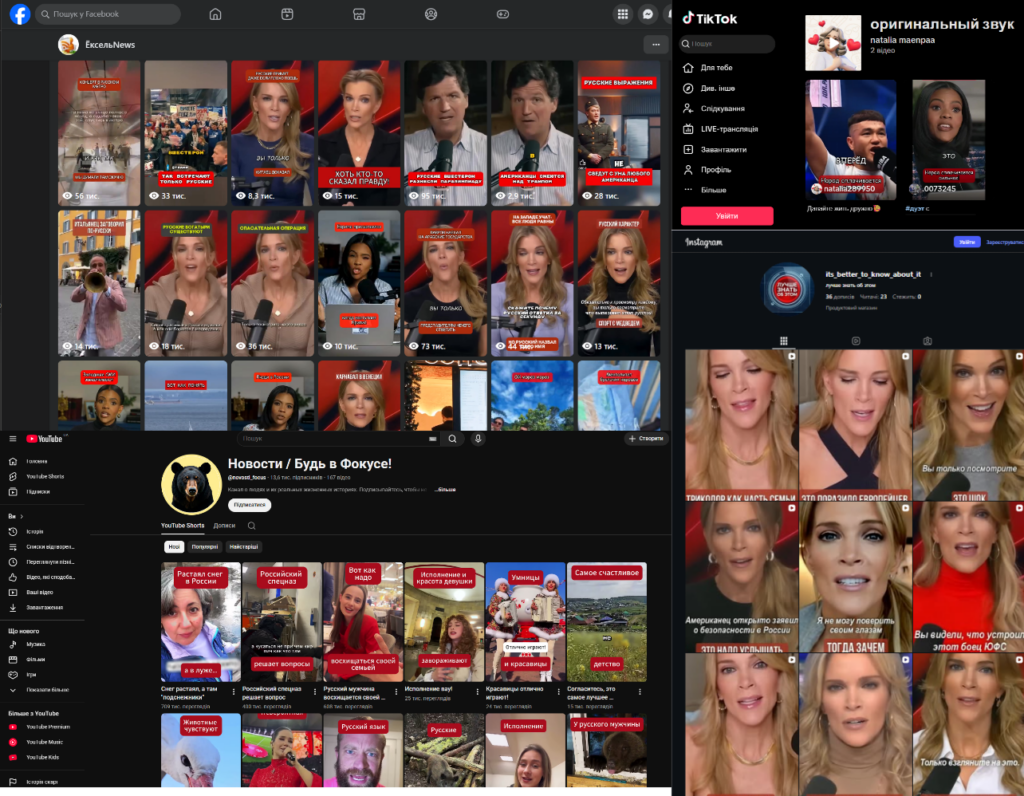
Examples of network accounts on YouTube, Instagram, Facebook, and TikTok promoting the “Russian World”
The mechanics of manipulation in one such video were analyzed by the American fact-checking organization Lead Stories. Using a viral video about “Slavic brotherhood” at a hockey match as an example, researchers proved that the footage featuring Tucker Carlson was a crude montage.
To create the illusion of support, the propagandists used a fragment of Carlson’s interview with Candace Owens from August 2025. In the original version, there was no mention of Russia or Belarus. The network’s authors simply overlaid Carlson’s facial expressions with a fabricated voiceover about “a true symbol of resistance that the West fears.”
The effectiveness of these videos is driven by two factors. First, algorithmic vulnerability: short-form videos (Reels/Shorts) are promoted more aggressively by algorithms. Users do not actively choose these videos; they appear in their feeds automatically due to high engagement levels.
Secondly, engagement and attention are guaranteed by the fact that these videos are built upon original user-generated or blogger content that is already inherently popular and gains high view counts on its own.
Key Messages and Narratives
The content of these videos is based on a classic set of Kremlin talking points, adapted for rapid consumption.
A significant portion of the content is built on a contrast between the “decaying” West (primarily the USA) and an “idealized” Russia. For instance, the audience is fed the idea that the quality of life and cultural standards in the Russian Federation are superior.
A separate layer of videos is dedicated to praising the manners and “humanity” of the Russian president. The authors use manipulative comparisons with Western leaders (such as Donald Trump), emphasizing that while the world “demonizes” Putin, he supposedly remains a “model of restraint, wisdom, and kindness.”
Propaganda clips also exploit images of the military and their upbringing. Through emotional captions, viewers are convinced that Russia is where “real men” and “future defenders” are raised, blending outward discipline with “inner kindness.” This directly correlates with Russia’s domestic policy of glorifying the military.
Some videos align perfectly with Russia’s current political agenda. For example, videos recently appeared within this network aimed at discrediting Telegram. Messages are being spread about the messenger’s vulnerability and alleged data collection by American intelligence agencies. Simultaneously, the audience is being gently nudged toward using the Russian platform MAX (which is positioned as a “routine” and secure tool).
This demonstrates that the campaign not only works on the country’s image but also fulfills specific technical tasks for the Kremlin regarding the forced migration of users to digital resources fully controlled by Russian intelligence services.
Who is the Campaign Targeting?
While the question of this campaign’s target audience remains open, certain factors allow for informed assumptions.
First and foremost, the choice of platforms (Instagram, Facebook, YouTube) appears illogical for a domestic Russian consumer, as these resources are officially blocked or restricted within the Russian Federation. For instance, Facebook and Instagram have been blocked in Russia since March 2022, and their parent company, Meta, has been designated an “extremist organization”.
Meanwhile, the use of the Russian language in captions and original audio tracks indicates that the campaign is aimed at the Russian-speaking populations. This is further evidenced by the sharing of such videos in thematic groups abroad — for example, in Bulgarian communities of pro-Russian supporters.
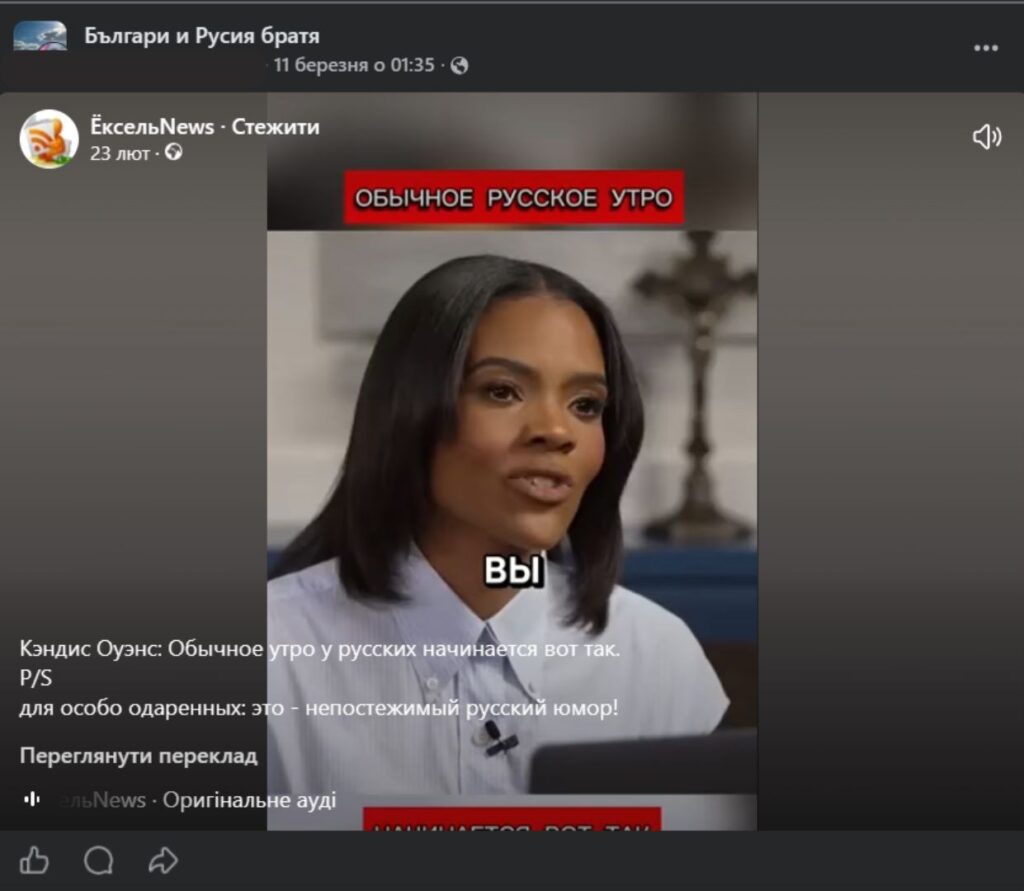
Example of the network’s content being shared in local Facebook groups
Special attention should be paid to the fact that on YouTube, alongside the Russian language, there is mostly high-quality automated English dubbing. This significantly expands the sphere of potential influence, reaching an English-speaking audience. Through recommendation algorithms, these users are fed an idealized image of the “Russian World,” reinforced by the recognizable faces of American conservatives.
We are witnessing a qualitative evolution of Russia’s “soft power.” Instead of straightforward news segments, propagandists have shifted to short-form reels that mimic entertainment or lifestyle content.
The use of Western media personalities, high-quality dubbing, and emotional “viral” storylines makes this network an effective tool for manipulation. The primary danger lies in the fact that these videos do not look like politics. They appear as random clips in your feed that appeal to fundamental values: kindness, mutual aid, and justice. However, behind this facade of “humanity” lies a clear objective: to legitimize Russia’s aggressive policies and discredit Western institutions.